The Nighttime Niggle: Are We Killing Our Mobiles?
Picture the scene: It’s 11:30 PM. You’ve just finished scrolling through the news (or let’s be honest, watching cat videos), and your eyes are getting heavy. You reach for the charging cable, fumble around for the port, and plug your phone in. The little lightning bolt appears. You’re ready for the Land of Nod.
But then, a nagging voice in the back of your head pipes up. Maybe it’s your dad’s voice, or perhaps a tech-savvy mate from down the pub. "You shouldn't leave that plugged in all night, you know. You'll fry the battery."
We’ve all heard it. The idea that leaving your smartphone connected to the mains while you sleep is a cardinal sin of technology ownership. It feels intuitively wrong, doesn't it? Like filling a cup of tea that’s already full—surely it’s going to spill over and make a right mess?
Well, grab yourself a cuppa and settle in. I’m here to tell you that you can sleep soundly. While your intentions are noble, this particular worry belongs in the tech history books, right alongside dial-up internet and blowing into video game cartridges.
The Myth: The Fear of the "Overcharge"
The belief is simple but persistent: if you leave your phone plugged in after it hits 100%, the charger will keep force-feeding electricity into the battery. This, so the theory goes, causes the battery to overheat, degrade rapidly, or—in the most dramatic imaginings—swell up and explode.
It’s a logical fear. In most areas of life, "too much" is a bad thing. Too much sun gives you burn; too much cake gives you a stomach ache. It makes sense that too much electricity would damage a sensitive piece of electronics.
This anxiety has led to some eccentric habits. I’ve met people who wake up at 3 AM just to unplug their phones. I’ve seen others who refuse to charge their device until it’s absolutely dead, believing they need to "empty the tank" before refilling it. It’s a lot of stress for a device that’s supposed to make our lives easier, isn't it?
The History: When Your Dad Was Actually Right
Here is the twist: this myth wasn't always a myth. Once upon a time, in the misty prehistoric era of the 1990s, it was absolute fact.
Back then, we were rocking Nokia bricks and power tools powered by Nickel-Cadmium (NiCad) or Nickel-Metal Hydride (NiMH) batteries. These old-school batteries were a bit dim. They suffered from something called the "memory effect." If you didn't drain them completely to 0% before charging them back up to 100%, they would chemically "forget" their full capacity. They’d start thinking 80% was full, and you’d lose a chunk of your battery life forever.
Furthermore, the chargers were "dumb." They didn't know when to stop. If you left a NiCad battery plugged in overnight, the charger would keep pumping current into it. Since the battery was full, that energy had to go somewhere—usually turning into heat. In severe cases, you really could "fry" the battery, causing it to melt or leak.
So, the advice to unplug immediately and drain fully was spot on—thirty years ago. We’ve just kept passing down the advice, even though the technology has changed completely. It’s a bit like refusing to drive a modern car over 60mph because you’re worried the radiator might blow, just because that happened to your granddad’s Austin Allegro.
The Truth: Meet the Bouncer in Your Phone
Today, things are very different. Modern smartphones—whether you’re Team iPhone, Samsung, or Google Pixel—run on Lithium-Ion (Li-ion) batteries. These are clever bits of kit. They don’t have a "memory," so you don't need to drain them to zero (in fact, please don't; they hate that).
More importantly, your phone is smarter than the charger. Inside every modern phone is a chip called the Battery Management System (BMS). Think of the BMS as a very strict bouncer at a nightclub.
Here is what happens when you plug in overnight:
- The Rush: The current flows in quickly to get you charged up.
- The Cut-Off: The moment your battery hits 100%, the BMS slams the door shut. It physically cuts off the flow of electricity to the battery. You could leave it plugged in for a week, and the battery wouldn't accept a single electron more.
- The Trickle: Of course, your phone is still on. It’s checking for Wi-Fi, listening for alarms, and running background updates. As it uses a tiny bit of power, the battery drops to 99%. The charger notices and sends a tiny "trickle" of power to top it back up, then stops again. It’s sipping, not gulping.
So, can you "overcharge" a modern phone? No. It is physically impossible with certified equipment.
Wait, is there a catch?
Well, slightly. While it’s safe, it’s not perfect.
Li-ion batteries don’t like extremes. They are happiest in the "Goldilocks zone" between 20% and 80%. Keeping a battery held at 100% voltage is a bit like keeping a rubber band stretched tight. It won’t snap immediately, but if you keep it stretched like that for 8 hours every night for two years, it eventually loses some of its ping.
However, the manufacturers are way ahead of us here. Have you noticed a setting called "Optimised Battery Charging" (on iPhone) or "Adaptive Charging" (on Android)?
This is brilliant stuff. Your phone learns your routine. It knows you usually wake up at 7 AM. So, when you plug it in at night, it charges to 80% (the comfortable zone) and then stops. It waits. Then, at about 6 AM, it tops up the final 20% just before your alarm goes off. It minimizes the time the battery spends under tension. Bloody clever, that.
Best Practices: How to Keep Your Battery Chuffed
So, if overnight charging is generally fine, what does actually kill your battery? Here are the real villains you should watch out for.
1. The Real Enemy is Heat
Heat is kryptonite to lithium-ion batteries. While charging overnight is safe electrically, it can be dangerous thermally if you aren't careful.
Do not charge your phone under your pillow. I can’t stress this enough. If the phone can’t breathe, the heat generated during charging builds up, and that will degrade the chemistry rapidly (and is a genuine fire hazard). Leave it on a hard surface, like a bedside table.
2. Avoid the "Deep Discharge"
Stop trying to drain your phone to 0%. That old advice is now harmful. Deep discharges stress Li-ion batteries. You are better off doing little "top-up" charges throughout the day. Treat your battery like you treat your hydration—sip often, don't wait until you're parched.
3. Use Certified Chargers
You don’t need to buy the expensive official brand cable, but please avoid the £2 chargers from the dodgy stall at the market. High-quality third-party brands (like Anker or Belkin) are great. Cheap knock-offs often lack safety regulators and can send unstable voltage to your phone. Our British plugs (BS 1363) are the safest in the world, fused and grounded, but they can only protect you so much if the cable itself is rubbish.
The Verdict: Sleep Tight
So, is charging your phone overnight frying its battery?
Absolutely not.
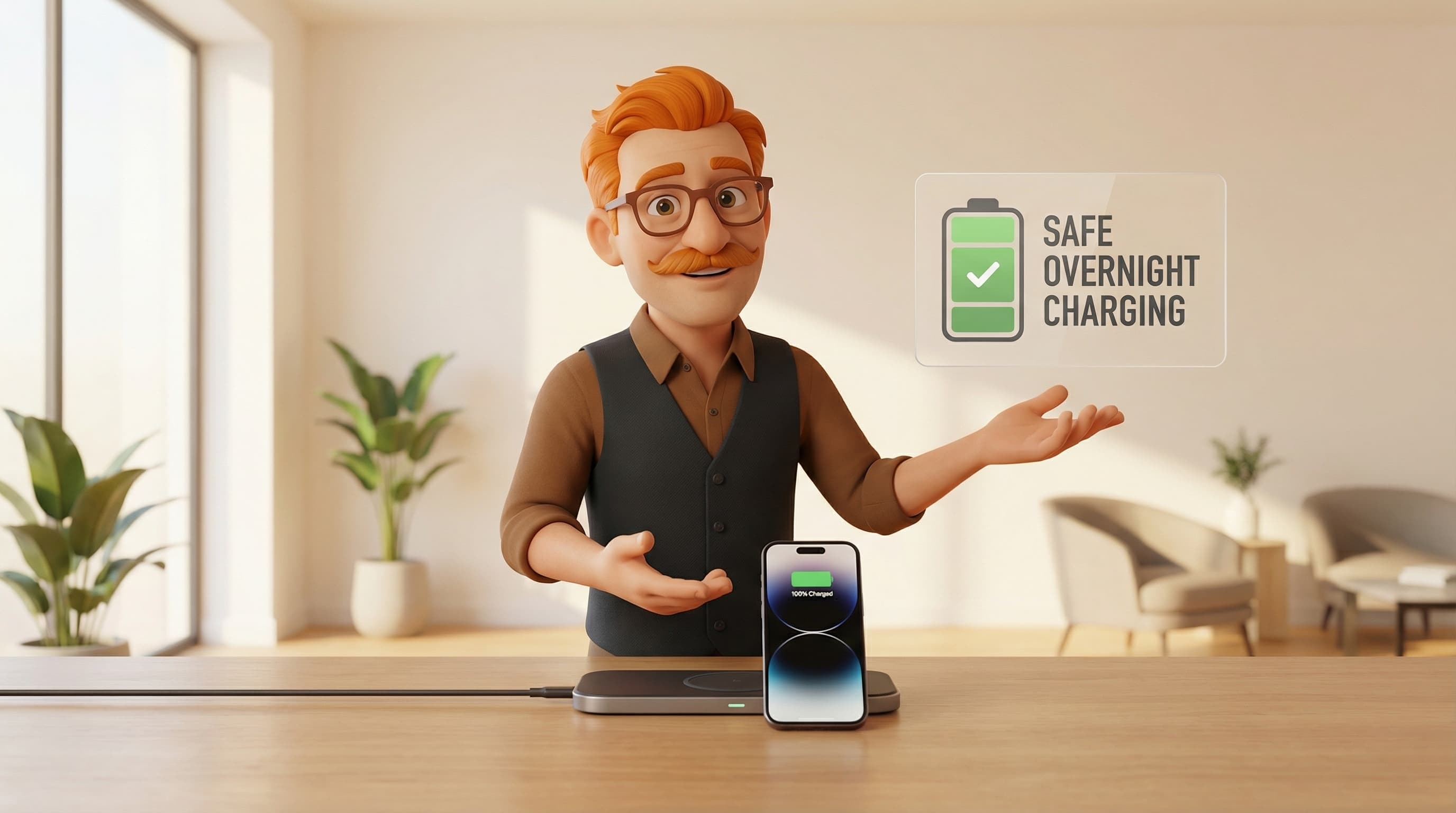
Your phone is smart enough to protect itself. The hardware prevents overcharging, and the software manages the charging speed to reduce stress.
If you want to be the absolute gold-standard battery preserver, you could meticulously keep your charge between 20% and 80% manually—but frankly, life’s too short for that faff. Just enable "Optimised Charging" in your settings, keep the phone on a cool surface, and enjoy your sleep. Your phone will be ready and waiting for you in the morning, safe and sound.
Need help finding a phone with a battery that actually lasts all day? Or perhaps a smart charger that does the thinking for you? Pop over to tod.ai. I’m always here for a chat to help you find the perfect tech for your needs. Cheers!
Related reading: