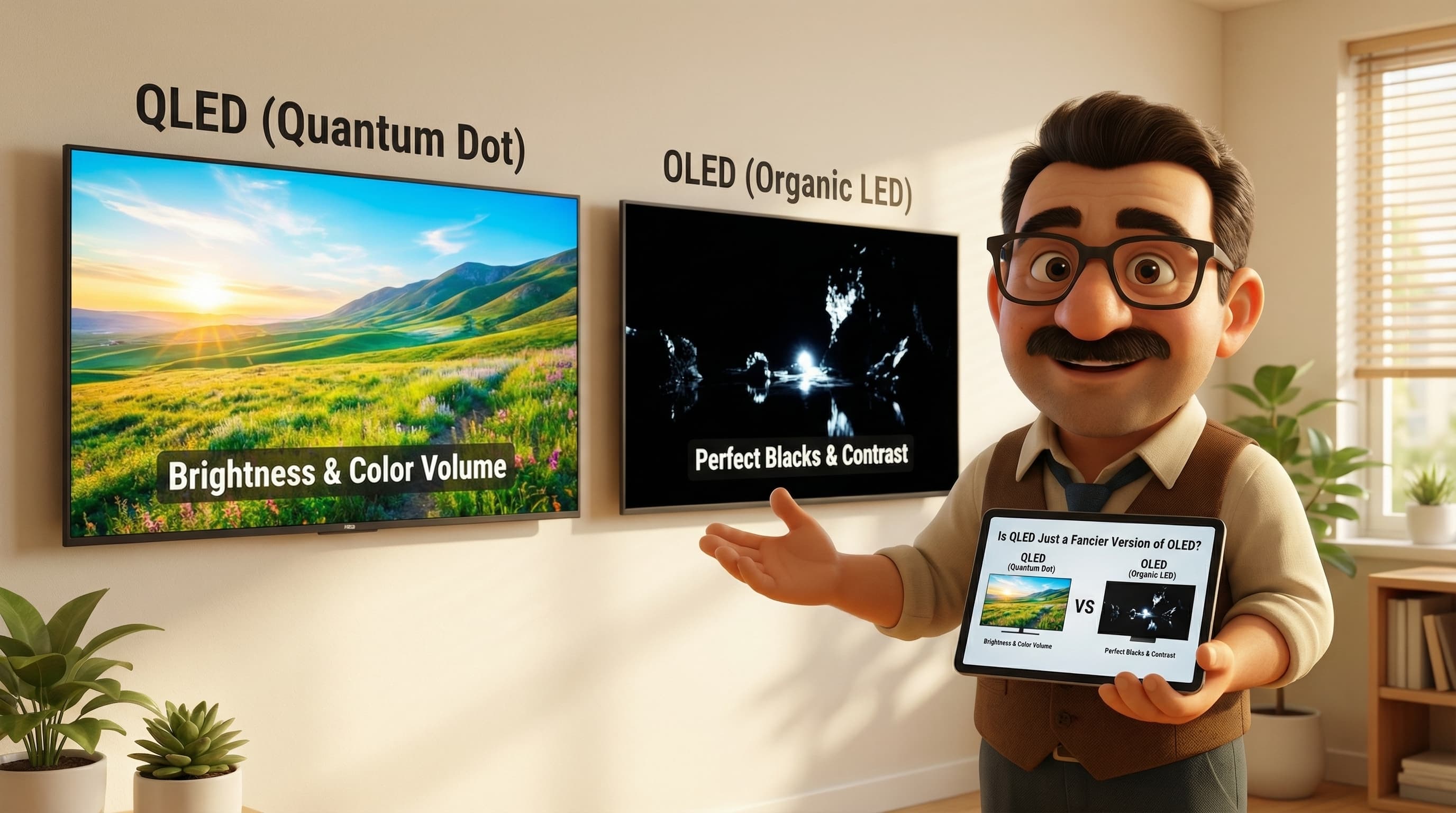
Is QLED Just a Fancier Version of OLED? Let’s Clear Up the Alphabet Soup
Hello there! Tod here. Pop the kettle on and settle in, because today we’re tackling one of the most persistent head-scratchers in the world of British tech shopping.
Picture the scene: It’s a rainy Saturday afternoon, and you’ve popped into your local Currys or John Lewis to escape the drizzle and perhaps treat yourself to a new telly. You stand before the Great Wall of Screens, mesmerised by the vivid colours of a nature documentary. A helpful salesperson approaches, gestures to a sleek 65-inch behemoth, and says, “And here we have the latest QLED model.”
You nod sagely, but your brain is doing cartwheels. “QLED?” you think. “That sounds an awful lot like OLED. In fact, looking at the box, that ‘Q’ looks suspiciously like an ‘O’ with a little tail stuck on it. Is it the sequel? Is it a typo? Is it basically the same thing but with a fancier marketing budget?”
If you’ve ever had this thought, you are absolutely not alone. It is, without a doubt, the most common question I get asked at tod.ai. The short answer? No, they are not the same. In fact, they are as different as chalk and cheese—or perhaps more accurately, as different as a torch and a candle.
But the long answer is a fascinating tale of marketing wars, clever engineering, and quantum physics (yes, really). So, grab your cuppa, and let’s debunk this myth once and for all.
The Myth: Why We Think They’re Twins
Let’s be honest, the confusion isn’t accidental. It’s a bit of a masterstroke in branding psychology.
Around 2017, the television market was heating up. LG had firmly planted its flag in the ground with OLED (Organic Light Emitting Diode) technology, which was widely regarded by tech reviewers as the gold standard for picture quality. Samsung, the other titan of the industry, needed a rival. They had been using terms like "SUHD" (Super Ultra High Definition), which, let’s face it, didn't exactly roll off the tongue.
Enter QLED.
Visually, the acronyms are nearly identical. In the hasty font of a price tag or a cardboard box, a Q looks remarkably like an O. It’s easy to see why so many consumers assumed QLED was simply the next alphabetical step in the evolution of OLED. It implies a relationship: "OLED was good, but Q comes later in the alphabet, so it must be better, right?"
This belief persists because both technologies represent the "premium" tier. When you’re spending upwards of £1,000 on a television, you expect the best. But believing they are the same technology under the hood is like believing a diesel tractor and a Tesla are the same because they both have four wheels and cost a bob or two.
The Technical Truth: The Sandwich vs. The Lightbulb
To understand why QLED isn’t just a fancy OLED, we need to peek under the bonnet. Don't worry, I’ll keep the jargon to a minimum—no lab coats required.
OLED: The Magic Pixels
Think of an OLED screen like a massive grid of millions of tiny, individual lightbulbs. Each pixel (dot) creates its own light and colour. This is what we call "emissive" technology.
Here is the party trick: when an OLED TV needs to show the colour black—say, a starry night sky or the dark corners of a horror movie—it simply switches those specific pixels off. Completely. The result is what geeks like me call "infinite contrast." The black is absolute. It’s why OLEDs look so stunning in a dark room; there’s no greyish glow washing out the picture.
QLED: The High-Tech Sandwich
Now, QLED (Quantum Dot LED) works entirely differently. It is "transmissive" technology.
At its heart, a QLED TV is actually a highly advanced version of the traditional LCD (Liquid Crystal Display) TVs we’ve had for years. Think of it like a sandwich:
- The Bread (Backlight): At the back, there is a panel of bright LED lights. These are always on (mostly) while you’re watching.
- The Filling (Liquid Crystals): These shutters open and close to let light through.
- The Secret Sauce (Quantum Dots): This is where the "Q" comes from. It’s a film layer containing microscopic nanocrystals—quantum dots. When light hits them, they emit incredibly pure, vibrant colours.
So, while OLED makes its own light, QLED relies on a backlight shining through layers to create the image. It’s like a stained-glass window (the QLED) versus a neon sign (the OLED). Both are beautiful, but they work on completely different principles.
Why The Difference Matters to Your Living Room
"Right then, Tod," I hear you say. "That’s all very clever, but does it actually matter when I’m watching Coronation Street?"
It matters immensely! Because they generate light differently, they have different strengths and weaknesses. Choosing the wrong one is the most common mistake British buyers make.
The Case for QLED (The Sun-Lover)
Because QLEDs use a powerful backlight, they can get incredibly bright. I’m talking dazzle-your-eyes bright.
Buy a QLED if:
- You have a bright room: If your living room has big windows, a conservatory, or you do most of your viewing during the day with the curtains open, QLED is the winner. It has the horsepower to cut through the glare of the sun.
- You worry about burn-in: Because QLEDs are essentially LCDs, they don't suffer from "screen burn" (where a static image, like a news ticker or a health bar in a video game, gets permanently etched onto the screen). If you leave Sky News on for 8 hours a day, QLED is your safest bet.
- You want vibrant colour volume: The quantum dots allow these TVs to display colours at peak brightness that other screens might wash out.
The Case for OLED (The Cinema Purist)
OLEDs are dimmer than their QLED cousins, but their precision is unmatched.
Buy an OLED if:
- You love Movie Nights: If you dim the lights, draw the curtains, and want a true cinema experience, OLED is unbeatable. The contrast is mesmerising. Seeing a bright torch in a dark cave without a "halo" of grey light around it is something you have to see to believe.
- You have a wide seating area: Because the light is produced on the surface, you can sit anywhere in the room—even that awkward armchair in the corner—and the picture remains perfect. QLEDs tend to lose colour if you view them from the side.
The Evolution: Muddying the Waters
Just to keep us on our toes, technology never stands still.
Samsung and other manufacturers have recently introduced Mini-LED (often branded as Neo QLED). Remember the "sandwich" analogy? Well, they’ve replaced the big LED lightbulbs at the back with thousands of tiny ones (Mini-LEDs). This gives them much better control over contrast, bringing QLED closer to OLED performance, though it still can't quite match that "perfect black."
On the flip side, OLED panels have started using "EX" technology and Micro Lens Arrays (MLA) to get brighter, narrowing the gap with QLEDs in sunny rooms.
And, just to make my job harder, we now have QD-OLED. This is a hybrid that combines the self-emissive nature of OLED with the colour-boosting Quantum Dots of QLED. It’s brilliant, but it’s also usually the most expensive option on the shelf.
The Verdict: Don't Buy the Acronym, Buy the Use Case
So, is QLED just a fancier version of OLED? Absolutely not. It is the pinnacle of LED/LCD technology, while OLED is a completely different beast entirely.
Neither is strictly "better" in a vacuum; it depends entirely on where you put it.
- Bright, busy family room with sunlight streaming in? Go for a QLED (like the Samsung Neo QLED range). It’s robust, bright, and punchy.
- Dedicated cinema room or evening viewing sanctuary? Go for an OLED (like the LG C-series or Sony A-series). The picture depth is emotional.
If you’re still standing in the shop aisle feeling a bit wobbly about which acronym belongs in your lounge, don’t panic. That’s exactly why I’m here. Just tell me about your room and what you love to watch, and I’ll sort the wheat from the chaff.
Need a hand finding the perfect model? Pop over to tod.ai and let’s have a chat. I’ll help you find the perfect telly without the jargon. Cheers!
Related reading: