Is Your Smart Speaker Spying? Let’s Have a Proper Natter About It
Picture the scene: You’re standing in the kitchen, waiting for the kettle to boil—because no problem in Britain was ever solved without a decent cuppa—and you’re chatting to your partner about, I don’t know, investing in a new set of golf clubs. You’ve never played golf in your life. You don’t own a pair of tartan trousers. But for some reason, you’re discussing it.
Twenty minutes later, you sit down on the sofa, open Facebook on your phone, and blimey! There it is. An advert for a shiny new TaylorMade driver.
A cold shiver runs down your spine. You glare at the little round speaker sitting innocently on the sideboard. The LED ring isn’t lit up, but you know. You just know. It’s been listening. It’s told Mr Zuckerberg about your secret golfing aspirations, and now the internet knows everything.
It’s a terrifying thought, isn’t it? The idea that we’ve voluntarily invited a corporate spy into our living rooms to listen to our rows, our gossip, and our terrible singing in the shower. But here at tod.ai, my job is to cut through the noise and find the best tech for you—and that means understanding how it actually works, warts and all.
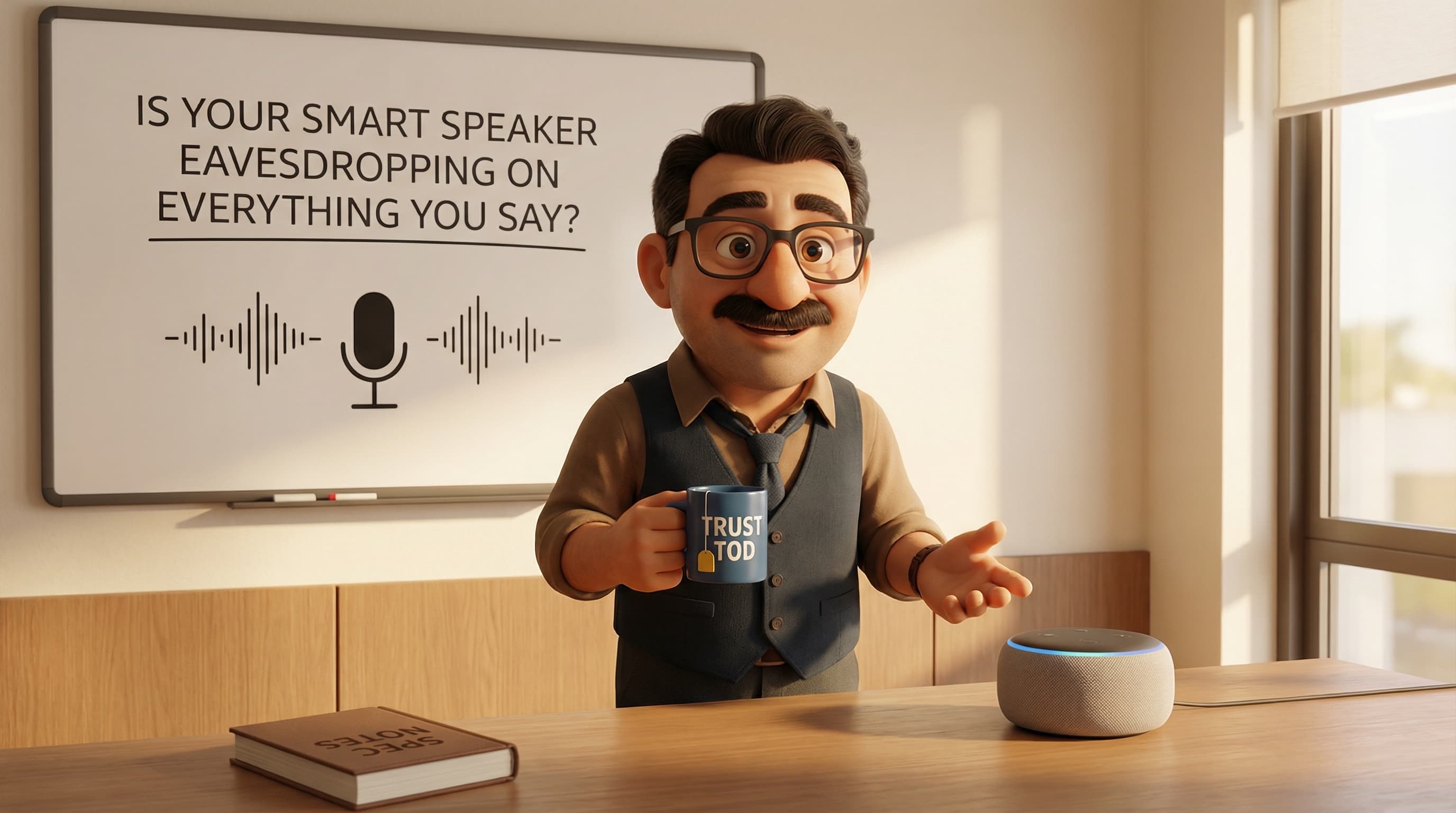
So, is your smart speaker eavesdropping on everything you say? The short answer is no. The long answer involves goldfish, invisible buffers, and a bit of a scandal from 2019. Let’s dive in, shall we?
The Origin of the Paranoia: Why We Think They’re Listening
Before we get into the nuts and bolts, we have to acknowledge that this fear didn’t appear out of thin air. It’s not just tinfoil-hat conspiracy stuff; it’s based on a very logical observation of the world around us.
Around 2017, when smart speakers like the Amazon Echo and Google Home started popping up in UK households faster than daffodils in spring, people started noticing these uncanny coincidences. You talk about something obscure—cat food, a holiday to Ibiza, a specific brand of toaster—and suddenly, the digital world is plastering adverts for that exact thing across your screens.
It feels like magic. Or rather, it feels like surveillance. Before we understood the terrifying brilliance of predictive data modelling, the only logical explanation was that the device must be recording our conversations. It was the only way to explain how the internet knew what we were thinking.
But there’s a massive difference between listening and recording. And to understand that, we need to look under the bonnet.
The Technical Reality: The Goldfish Memory
I often hear people say, "But Tod, the device has to be listening, otherwise how does it hear me say the wake word?"
You’re absolutely right. Technically, the microphone is always on. But—and this is a massive 'but'—it is not recording.
Think of your smart speaker like a very obedient, slightly forgetful butler standing outside a closed door. This butler has been given strictly one instruction: "Listen for the bell." He is standing there, listening intently. He hears the wind, the cat meowing, and you shouting at the telly during the football. But he ignores it all. He doesn’t write any of it down. He doesn’t tell his boss. He just waits for the bell.
In tech terms, this is called "The Buffer Loop."
- The 3-Second Loop: Your device (whether it's an Echo, Nest, or HomePod) is recording audio into a temporary local memory bank (RAM) that lasts about three seconds.
- The Overwrite: Every second that passes, the oldest second of audio is deleted and overwritten by the new second. It’s like a goldfish; it constantly forgets what it heard three seconds ago.
- The Chip: This process happens on a low-power chip inside the device itself. It is not connected to the internet during this phase. It is purely local.
Nothing—absolutely nothing—is sent to Amazon or Google’s servers until that specific chip hears the "Wake Word" (like "Alexa" or "Hey Google"). Only then does the device wake up, light up, and open the encrypted channel to the cloud to process your request.
The "Ghost" in the Machine
"But Tod," you say, "I’ve seen it light up when I haven’t spoken to it!"
Ah, yes. The infamous "False Accept." This is where the technology gets a bit dodgy. The software isn't perfect, especially with our delightful variety of British accents. If you’re watching a film and someone says "I like her," a smart speaker might mishear that as "Alexa."
When this happens, the device does start recording. It thinks you’ve summoned it. It sends that snippet of audio to the cloud. Usually, the server realises the mistake quickly—it hears "I like her," realises that’s not a command, and tells the device to go back to sleep. But for those few seconds, yes, it was recording by accident.
Data shows this happens anywhere from 1.5 to 19 times a day depending on how noisy your house is. It’s annoying, and it’s a privacy niggle, but it’s a glitch, not a surveillance strategy.
The Ad Coincidence: If It’s Not Listening, How Does It Know?
This is the bit that really bakes people’s noodles. If the speaker didn't hear me talk about golf clubs, why am I seeing the advert?
The answer is actually creepier than a listening microphone. It’s called Data Aggregation.
Tech giants don’t need to listen to your voice to know what you want. They already know everything else about you. Let’s look at that golf club scenario again:
- Location Data: Your smartphone’s GPS knows you spent two hours at a coffee shop yesterday.
- Social Graph: It knows your phone was sitting two feet away from your friend Dave’s phone for those two hours.
- Purchase History: Dave recently bought a set of TaylorMade golf clubs and has been searching for driving ranges.
- The Algorithm: The computer puts 2 and 2 together. "Tod hung out with Dave. Dave loves golf. Friends usually influence each other. Tod is a male aged 30-45 with disposable income. Let’s show Tod the golf clubs."
They didn't hear you talking about golf. They just predicted that because you were hanging out with Dave, you might be interested in golf. And when they get it right, you notice it. When they show you an advert for feminine hygiene products or cat food and you don't have a cat, you ignore it. It’s confirmation bias at its finest.
The Skeleton in the Closet: The 2019 Scandal
Now, I’m a friendly chap, but I’m honest. I can’t gloss over the fact that the tech companies have breached our trust in the past. This is where the myth finds its strongest footing.
Back in 2019, a massive scandal broke. It turned out that Amazon, Google, and Apple were all employing human contractors to listen to a tiny percentage (less than 1%) of voice recordings. The goal was to grade the AI—to check if Alexa understood "Play The Beatles" correctly or if she messed up.
The problem? They didn't tell us they were doing it. Whistleblowers revealed that these contractors sometimes heard private moments—domestic arguments, confidential business deals, and worse—that had been recorded during those "false activations" I mentioned earlier.
It was a PR nightmare. The public was rightly furious. But, strangely enough, this scandal is the reason your device is safer today.
The Post-2019 Cleanup
Because of the backlash (and the terrified lawyers looking at the UK’s GDPR laws), the industry changed overnight:
- The Opt-In Rule: Human grading is no longer the default. You have to actively go into your settings and say, "Yes, I want to help improve the software."
- The ICO Watchdogs: The UK’s Information Commissioner’s Office has teeth. If these companies were secretly recording 24/7, they would be fined up to 4% of their global turnover. That’s billions of pounds. It’s simply not worth the risk for them to spy on you to sell you socks.
- Network Evidence: Independent security experts have analysed the network traffic of these devices. If they were streaming 24/7 audio, your broadband usage would skyrocket. The data packets just aren’t there.
Tod’s Verdict: Safe, But Be Smart
So, where does that leave us? Are smart speakers evil spies? No. Are they perfect? Absolutely not.
They are incredibly useful tools that can revolutionise how you run your home, but like any tool connected to the internet, they require a bit of common sense. The reality is that your smartphone—the thing you take into the bathroom, the bedroom, and the pub—is tracking you far more aggressively via GPS and app usage than your Echo ever could sitting on the kitchen counter.
Here is my advice for enjoying the tech without the worry:
1. Check Your Settings
Pop into the Alexa or Google Home app and find the "Privacy" section. You can listen to everything the device has recorded. If you see anything you don't like, delete it. You can also set it to auto-delete recordings every 3 months.
2. Use the Mute Button
If you’re having a deeply private conversation, or perhaps discussing a bank robbery (I don’t judge), reach over and press the mute button. It physically disconnects the microphone circuit on most devices. The ring turns red, and the ears are closed.
3. Embrace the Convenience
Don’t let the myths stop you from enjoying the tech. Setting timers while your hands are covered in dough, controlling the lights from the sofa, or getting a quick weather update—these are little luxuries that make life easier.
The bottom line: Your smart speaker isn't interested in your secrets. It just wants to know if you want the heating turned up or a Spotify playlist put on. And frankly, considering how much I talk to my dog, I think anyone listening to my house 24/7 would die of boredom within the hour.
Need help finding a smart speaker that respects your privacy? Or maybe you want to upgrade your smart home setup? Pop over to tod.ai and let’s get you sorted with the perfect kit.
Related reading: